Price and cost of a charger.

Anyone who wants to install a charger quickly runs into a question with no single answer: what does that actually cost? There’s no fixed price for “a charger,” because the model, the electrical connection, the distance to the meter cabinet and the installation itself together determine the amount. This page explains which choices drive the price, what to look out for in a quote, and what often falls outside the first price you’re shown. For an amount tailored to your situation, request a quote from an approved installer.

What does a home charger cost?

The price of a home charger depends on a series of concrete choices, not on one fixed amount. The biggest factors are the model you choose, whether the connection is single-phase or three-phase, how far the meter cabinet is from the desired location for the charger, and whether groundwork is needed if you choose a free-standing unit instead of a wall-mounted one. A power limiter or a separate meter for load balancing also plays a role. Veton® doesn’t go for the cheapest option, but for a charger that lasts for years without compromising on design or reliability. Request a tailored quote through an approved installer.

How much does a home charger cost?

This question has two layers: the price of the unit itself, and the cost of the installation around it. The unit varies with the model and the power rating. The installation varies even more, because it depends on the distance to the meter cabinet, whether cable trunking or groundwork is needed, and whether the existing electrical installation is already prepared for a charger. Anyone comparing quotes should therefore always ask for both amounts separately, so a low “from” price for the unit doesn’t hide the fact that the installation itself can be the largest part of the bill.

What does a home charger cost in Belgium?

In Belgium, the cost differs by region, because the grid operator’s connection conditions, inspection rules and any local incentives are not the same everywhere. Flanders, Wallonia and Brussels each run their own schemes, and these change regularly, so a scheme that applies today may look different next year. One thing is fixed: the federal tax reduction for a home charger bought by a private individual no longer exists from tax year 2026, so leave it out of your calculation. What does apply everywhere: the installation must be inspected and approved by an accredited inspection body before it can be used. Ask your installer about the current rules in your region, and have an accountant confirm the fiscal side.

What does a charger cost?

Without context this is a broad question, because a charger for a single-family home and a charging point for a business car park with multiple connections sit in entirely different price categories. What matters is the model and the power rating, whether it’s a single charging point or a project with several points, and whether control is needed such as load balancing or integration with an energy management system. With multiple charging points on one site, a shared technical setup can bring down the cost per point. You only get a concrete amount after a quote, since that takes the specific situation on site into account.

How much does a charger cost?

Apart from the model itself, a large part of the cost sits in what you don’t see right away. Think of running cabling from the meter cabinet to the charger, any breaking-out or groundwork, an upgrade to the fuse box, and the inspection afterwards — required in Belgium, though requirements differ by country. Two quotes for the same charger can therefore differ sharply if one installer includes those items and the other doesn’t. Always ask for an itemised quote, not a single round total, so you can see exactly what you’re paying for and compare quotes fairly.

What does a smart charger cost?

A smart charger usually isn’t a separate, more expensive unit next to an “ordinary” charger, because the intelligence sits in the control logic and the app, not in a separate add-on you buy alongside it. Veton® chargers come standard with an app for choosing a charging mode, such as charging fully on solar power or charging within a preset power limit, and that app is free, with no subscription or monthly cost. What can raise the price is additional control, such as dynamic load balancing across multiple charging points or integration with an existing energy management system. It’s best to discuss that with your installer beforehand.

What does a business charger cost?

Business projects differ from a residential installation on several points. They usually involve multiple charging points at once, which calls for careful load balancing so the site connection isn’t overloaded, and sometimes the available grid capacity needs to be extended before charging can even start. Practical choices also come into play, such as access control, per-user billing through an OCPP platform, and whether the project rolls out in phases. For businesses and project developers, Veton® works with an architecturally designed charger that stays visually consistent across multiple charging points too.

Is a charger tax-deductible?

That depends on who you are and where you are. For private individuals in Belgium, the federal tax reduction for a home charger no longer applies: it was abolished from tax year 2026. Beyond that, tax incentives for charging infrastructure — for businesses in Belgium, and under separate schemes in the Netherlands — vary by situation and change over time, so Veton® deliberately doesn’t name specific percentages, amounts or scheme names here. Check the current rules with your accountant, the FPS Finance (Belgium), or the RVO (Netherlands), before basing a purchase decision on a tax advantage.

How does a charger work?

A charger is essentially a switch with a brain: it connects the socket of your electrical installation to the car, and decides how much current is allowed to flow at any given moment. As soon as you plug in the cable, the charger recognises the car and starts the communication that determines how much power can be delivered safely. At Veton®, the sensitive electronics don’t sit in the outdoor unit itself, but in a separate technical cabinet inside the building, which protects the components from moisture, temperature swings and dirt. Through the app you then choose how charging happens, for example at full power or only on surplus solar energy.

What is a smart charger?

A smart charger is a charger that can think along with your energy situation, instead of simply being on or off. It actively adjusts the charging power based on settings you choose yourself, such as charging exclusively on solar surplus, charging within a set maximum power, or spreading charging across multiple charging points so the main connection isn’t overloaded. Veton® chargers run on an open OCPP architecture, which means you’re not locked into one platform, and integration with existing home automation or energy management systems is possible. All charging modes are explained in detail on the FAQ about charging modes and the Veton® app.

Which cable for a charger?

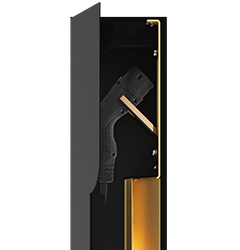
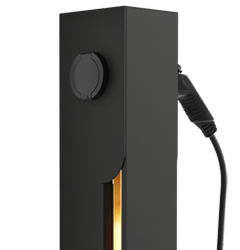
Which cable you need depends on the model you choose and the power rating of the installation. Some Veton® models, such as the One, have an integrated cable that disappears completely behind a flap when you’re not charging. Other models work with a socket on the charger, where you use your own separate Mode 3 charging cable with the plug type that matches your car. Between the indoor cabinet with the electronics and a single charging point, a 5G 4 mm² power cable typically runs alongside a CAT7 data cable; with a dual charging point like Two, that becomes a 5G 6 mm² power cable per charging point. The correct cable cross-section and the type of protection further depend on the actual cable run length, and an approved installer determines that based on the specific situation, not a general rule of thumb.

Which RCD for a charger?

A charger must always be protected by an RCD suitable for electric vehicle charging, because an ordinary household RCD isn’t always designed for that. During charging, a DC component can appear in the fault current signal that a standard device won’t detect. Veton® installations typically use one of two options: an external 4-pole type B RCD rated 30 mA, or an external type A RCD circuit breaker rated 30 mA combined with the built-in 6 mA DC residual current monitoring module that comes standard in the charger, which makes the type B device unnecessary. Which of the two fits best depends on the existing installation and the power level, and an approved installer determines that at inspection, based on the applicable electrical regulations. Ask your installer to explicitly confirm which of the two options is fitted before the installation is inspected.

How do you install a charger?

Installation starts with a site visit, where an installer looks at the distance to the meter cabinet, the available capacity and the desired location for the charger. Cabling is then run, the installation gets its own protection in the fuse box, and the charger itself is mounted, on a pedestal or against a wall depending on the model. The installer then connects the charger, configures it, and links it to the app where desired. As a final step, an accredited inspection body must approve the installation before it can be used — in Belgium this inspection is mandatory, and other countries set their own requirements. This entire process runs through an approved installer, never as a stand-alone DIY job.

Want to know what a charger costs in your situation? Request a tailored quote from an approved Veton® installer. Send a photo of the spot where the charger needs to go, and you’ll get a price matched to your own connection, not to an average.

Back to the full FAQ, or to contact for a tailored quote.