Chargers for businesses.

Business chargers with load balancing, an open platform and five years of on-site warranty.

veton enterprise hero
Veton Two charging station on a gravel path at Cleydael Golf & Country Club, hedge and castle turret behind.

A charging solution for every kind of building.

A charger for business use isn’t deployed the same way everywhere. At an office it sees changing occupancy from morning to evening, at a hotel it fills up mainly overnight, and at a car dealership it needs to keep charging different vehicles without an employee having to step in. Whether it’s a charger for a head office, a charger for a smaller branch, or chargers across an entire business park, Veton® delivers business charging solutions from the same technical foundation, with a design that suits the building where the charger stands. Architects and property developers who want a charging spot that doesn’t disrupt the building find in Veton® Enterprise a supplier that plans for that from the first sketch.

What the building's connection can actually carry.

In a business installation, the question is rarely whether there’s room for one charger, but how many chargers the building’s connection can carry without putting the main fuse at risk. Anyone who wants to equip ten parking spaces without reserving the connection’s full capacity for that purpose needs load balancing: the chargers automatically divide the available power, so everyone can charge without raising the building’s peak load.

Load balancing and energy management for larger sites. For smaller installations, Veton® handles that division directly between the chargers themselves. As a site grows, Vetonlm takes over, Veton®’s energy management system that can control more than a hundred charging points at once while dividing power fairly across active charging sessions. The system also accounts for other large consumers on site, such as a heat pump or a production line, so the chargers never become the weak link in the building’s energy management. Anyone who already has an energy management system or building management system can simply connect the chargers to it, because Veton® works with an open architecture for load balancing and energy management, not a closed ecosystem.

What the law requires, and where. The EU’s recast Energy Performance of Buildings Directive (EU) 2024/1275 sets a baseline in Article 14: new-build and major-renovation non-residential buildings with more than 5 parking spaces need one charging point per 5 spaces (one per 2 for office buildings), with pre-cabling for at least half the spaces and ducting for the rest. But a directive binds member states, not building owners — it’s the national transposition that actually applies, and that transposition differs from country to country. As of August 2026, the Netherlands matches Article 14 almost exactly, in force since 29 May 2026. Flanders currently asks for at least 2 charging points above 10 spaces, with ducting for 1 in 4. Germany currently requires just 1 point above 6 spaces, a threshold that tightens sharply from 1 January 2027. Which rule applies depends on where the building stands, so check the requirement for your country and building type before you plan a project.

Veton load management — site dashboard
Two Veton charging stations on a lawn beside a modern building, socket outlet visible.

Open platform, no vendor lock-in.

Business chargers rarely operate in isolation. Sessions need to be billed, linked to employees or customers, and tied into the billing or backoffice platform the business already uses. Veton® charging points support OCPP, the open standard that lets almost any charging card and billing platform connect, so there’s no obligation to stay with one specific provider. Anyone working with one platform today and wanting to switch tomorrow can do that without replacing the charger itself.

Billing and reimbursement for employees. Many businesses want to track charging for company cars or employees’ private cars separately, to reimburse or invoice the cost correctly. Because Veton® works through open OCPP connections, that tracking runs through the backoffice platform of choice, not through an in-house system you’re locked into. The choice of charging card, tariff structure and reporting stays with the business, not with the manufacturer of the charger.

A charger that suits the building's entrance.

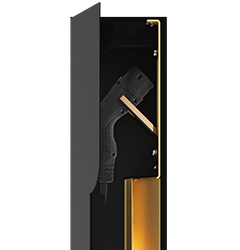
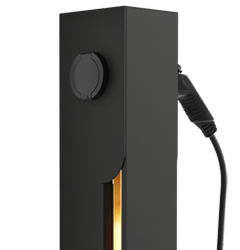
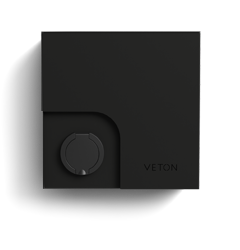
With many business chargers, the technology still shows on the outside: a grey box with visible cabling next to the entrance. Veton® deliberately builds it the other way round, with the sensitive electronics in a separate cabinet inside the building and only a cleanly designed pole on the outside. On Veton One, the entire charging cable disappears behind a recessed flap, and on Wall Plus both the cable and the connector hide behind it, so nothing hangs loose against the façade. On most models the lighting also runs vertically along both sides, while the front stays quiet with only the logo at the bottom. For architects and property developers who want a consistent design language across an entire project, that goes beyond a single pole: the same signature is available across the building’s entire charging infrastructure, from a single spot to a full car park. What exactly makes this design a design charger is covered in our overview of the category.

Two Veton Wall Plus chargers on a corten steel facade at the entrance, visitor signage alongside.
Veton charger housings in four colours: green, blue, white and black.

Total cost of ownership, not the purchase price.

Investing in charging infrastructure can bring a financial advantage, but the incentives that apply differ by country, depend on the type of business and the investment, and change over time — sometimes on a fixed end date. Because the details shift so often, discuss what currently applies with your accountant or financial adviser before making an investment decision. More important than the purchase price alone is what a charger actually costs over five to ten years. A cheap charger that fails after a few years because of moisture or temperature swings inside an outdoor enclosure is rarely the better deal, even if the sticker price suggests otherwise. Because Veton®’s electronics sit indoors, shielded from weather and insects, and the warranty runs five years on-site, the operating cost stays predictable instead of climbing after the first breakdown. A detailed breakdown of every cost factor is in the FAQ on the cost of a charger.

Installing a charger for a business differs from installing one for an individual building owner, because the connection, the number of parking spaces and future expansion all shape the design. Veton® works with a network of certified installers who handle both the technical side and the placement of the outdoor unit, and think through the number of charging points, phasing and the site’s energy balance in advance. Veton One, Two, Wall and Wall Plus also carry the CE mark, with a signed declaration of conformity for the Low Voltage Directive and the EMC Directive under EN 61851-1, set out in chapter 7 of the user manual at veton.be/downloads/.

FAQ

Business charging FAQ.

Practical answers on cost and installation for anyone weighing up charging at a single business site.

Directive (EU) 2024/1275 sets the baseline: new-build or renovated non-residential buildings above 5 spaces need 1 point per 5 (1 per 2 for offices), pre-cabling for at least half, ducting for the rest. Existing buildings above 20 spaces: 1 per 10, or ducting for at least half, by 2027. A directive binds member states, not owners — national transposition applies. The Netherlands matches it since 29 May 2026. Flanders requires 2 points above 10 spaces, ducting for 1 in 4. Germany requires 1 point above 6 spaces, tightening from 2027. As of August 2026.

The legal minimum is a floor, not a plan. What you need depends on how many cars are on site at once and how long they stay. On a business car park where cars sit for half a day, four to ten charging points cover most SME sites: enough for staff and visitors without anyone waiting or having to move a car. Two to five dual chargers deliver that range, since each houses two independent charging points in one footprint.

Usually not. Every Veton charger has dynamic load balancing built in as standard: the system measures what the building is drawing at that moment and shares what remains across the charging points. If available capacity drops, the charging points throttle back together instead of overloading the main fuse. Whether a heavier connection is needed regardless depends on the specific site, and that call belongs to an approved installer.

Two cars need two charging points, not necessarily two poles. Veton Two houses both charging points in a single enclosure, each with its own MID-certified meter and its own controller, so both charge at once and independently. Priced per point, a dual unit spreads the cost of a design charger across two points instead of one. On a car park it also means less groundwork and less visible mass than two separate poles.

Yes. Every charging point has its own MID-certified meter, which is the condition for settling charging costs verifiably between employer and employee, or for billing a visitor. Access is controlled with a local RFID whitelist held in the charger itself, so no network connection is required to authorise a session. For billing or reporting per user, connect the chargers to the OCPP platform of your choice.

The standalone Veton load-management system drives more than 100 charging points on a single grid connection, sharing capacity fairly across the three phases and protecting the site's peak-demand tariff. It runs locally on site, so it keeps working when the internet connection drops, and it needs no cloud subscription to operate.

Yes. The chargers support OCPP and expose an open Modbus/TCP interface, so an existing EMS or building management system can control them directly. Niko Home Control, Loxone, Qbus, KNX and Home Assistant are common integrations. You choose your own OCPP back office for billing and reporting, and can switch providers later without replacing any hardware.

No. Load balancing, smart charging and the app are included in the price of the charger. There is no subscription per charging point, no paid tier to unlock features, and no recurring software cost to keep them working. At ten charging points, that is the difference between a single upfront investment and a line item that recurs every year.